

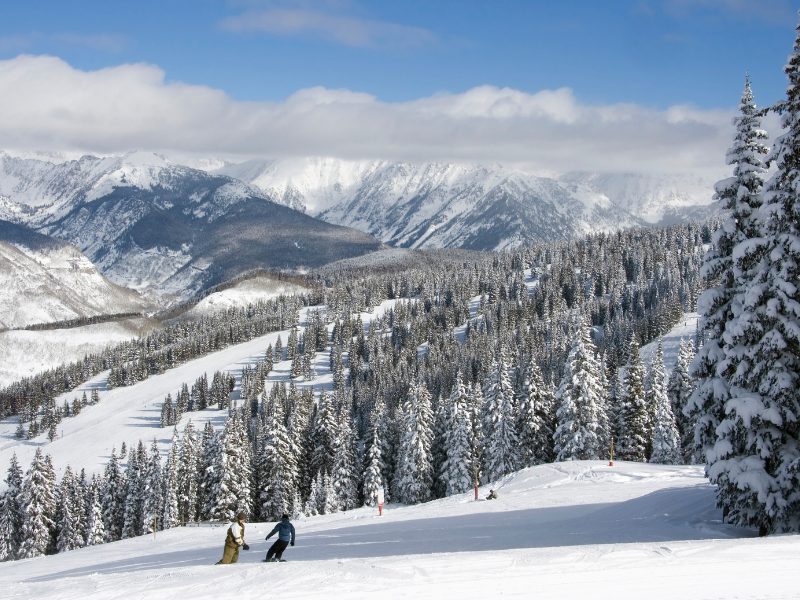
Between December and March, the drive from Denver International Airport to Vail is some of the most demanding interstate driving in the country. It is about 118 miles and roughly two hours when everything cooperates. On a Saturday in January after an overnight storm, two hours is a fantasy.
This page is about what actually happens on that road, what the law now requires of your vehicle, and where a private chauffeur genuinely changes the outcome rather than just the comfort level. Some of it argues against booking a car. We would rather you had the real picture.
The route, and the two things that make it hard
Westbound from the airport you cross the metro, climb through the foothills, and then go over two of the highest crossings on any interstate in America.
The Eisenhower-Johnson Memorial Tunnels take I-70 under the Continental Divide at 11,158 feet at the highest point. That is the highest point on the entire Interstate Highway System. There is no exit inside, and when the tunnel closes, the alternative is Loveland Pass on US-6 at 11,990 feet, which is a very different proposition in weather.
Vail Pass tops out at 10,662 feet and is the one that catches people. It is steep on both sides, up to a seven percent grade, and there are two runaway truck ramps on the westbound descent for a reason. Vail is the only major Colorado destination whose drive crosses both the tunnel and Vail Pass. Breckenridge leaves the interstate at Exit 203 and Keystone at Exit 205, both of them before the pass. You do not get to skip it.
Why the weather forecast you checked is not the weather you will drive
The single most common mistake is checking conditions in Denver, or in Vail, and assuming the drive matches. It frequently does not. It can be dry and sunny at the airport, snowing hard at Georgetown, clear again at Silverthorne, and a whiteout on Vail Pass, all inside ninety minutes.
Ski-weekend traffic has its own physics on top of that. Westbound Saturday mornings and eastbound Sunday afternoons are the two worst windows of the week, and they are predictable enough that locals plan their entire trip around avoiding them. CDOT also closes the corridor outright several times each season, sometimes for hours, and when it reopens everyone who was waiting departs at once.
None of this is unusual. It is a normal winter on I-70. It is just not what someone flying in from sea level is picturing when they book a rental car.
Construction at Floyd Hill, through 2029
Worth knowing before you plan your timing. CDOT is rebuilding an eight-mile stretch of I-70 from west of Evergreen to eastern Idaho Springs, adding a third westbound lane that will run as an Express Lane, along with a new frontage road section and interchange work.
Construction started in July 2023 and reached its halfway point in July 2026. I-70 moves into its new alignment in 2028, with full completion expected in 2029. The heavy rock blasting is substantially complete, which has cut the traffic holds considerably, but overnight single-direction closures and traffic shifts continue through the project.
The practical version: this is a stretch where the road you drove last season may not be the road you drive this season, and where a driver who runs the corridor weekly is worth more than a navigation app.
What a chauffeur actually changes
Not the leather. Four specific things.
The vehicle is equipped and the driver has done this before. Our vehicles are prepared for winter mountain driving and this corridor is routine work between September and May. Ask us what is fitted to the vehicle assigned to your booking and we will tell you before you pay. That is a fair question to put to every operator you are comparing, and the answers will differ.
You are not driving after flying. A four-hour flight, a time-zone change, an altitude change from sea level to 11,158 feet, and then a mountain pass in the dark is a genuinely poor combination. This is the argument that persuades most people, and it has nothing to do with luxury.
The pickup is tied to your flight, not the clock. Give us the airline and flight number at booking rather than a landing time. A delay moves your pickup rather than voiding it. On a route this long we are dispatching a vehicle well ahead of you, and flight tracking is the whole reason that works.
Your gear travels with you. Skis, boards, boot bags and the enormous suitcase somebody always brings. Tell us bag count as well as passenger count at booking, because on this route luggage volume decides the vehicle more often than headcount does.
Where to meet us at the airport
Pre-arranged black car pickup at Denver International is on Level 5 of Jeppesen Terminal, Island 2, where there is a limo booth for check-in. East side, doors 505 to 507 and 511 to 513. West side, doors 504 to 506 and 510 to 512.
Rideshare picks up on Island 5, through an overlapping set of the same doors. This trips people up constantly, because the door number does not tell you which island you are standing on. The island number does. If you remember one thing from this section, remember Island 2.
Your chauffeur can meet you inside the terminal when it is arranged in advance. Two things no operator is permitted to do, us included: take bags off the baggage carousel, and hand out luggage carts. Be suspicious of anyone who promises either.
What it costs, and how to compare it honestly
Transfers are quoted as a flat rate per vehicle, not per person. Two people and six people in the same SUV pay the same figure, which means every comparison you run against a per-seat option has to be converted before it means anything.
Rates are on our rates page, and we will confirm the figure for your trip when you get in touch.
Two things worth checking in any quote you receive, ours included: whether tolls are inside the number, and whether gratuity is added automatically afterwards. Several operators in this market publish an attractive headline figure and then add a fixed gratuity of twenty percent on top, with tolls still outside it. A quote that excludes both is not comparable to one that includes them.
Against rideshare
Quotes look tempting until you try to get one. A 118-mile mountain fare is a trip many DEN drivers decline, surge on that distance can land above a private quote, and the return leg out of Vail is harder to source than the outbound. The driver who does accept may never have driven Vail Pass in February, and their vehicle may not meet the traction requirement. That is not a plan.
Against a shared shuttle
A legitimate option for one or two people traveling light. Seats generally run somewhere around $60 to $140 per person each way in winter depending on date and lead time. At four people that is roughly $240 to $560 for the leg, on a fixed departure, with other properties served before yours. Convert to a per-vehicle number before you compare.
A note on flying into Eagle instead
Eagle County Airport is about 37 miles and 40 minutes from Vail, and if the fares work out, flying into EGE is a genuinely better trip than driving from Denver. We should be straight with you about our part in that: we are a Denver operator and we drive the Denver end. We do not run the short local leg between Eagle and Vail, so if you fly into EGE you will need to arrange ground transport at that end. We can run you from Denver to Eagle by road, which is occasionally what people need when a regional flight is cancelled, and in a bad winter that happens more than the airlines advertise.
How to book, and what to send
Four things: your date, your flight number, your party size including bag and ski-bag count, and your exact address in Vail Village, Lionshead, West Vail or East Vail. You get a firm figure in writing before anything is charged.
Book early for peak dates, and book the return at the same time as the arrival. The vehicles that can carry a family plus six ski bags over two mountain passes are a finite pool across the whole Front Range, and in the last week of December that pool is spoken for well in advance. Early morning departure slots go first, because everybody is solving the same problem on the same Sunday.
Frequently asked questions
How long does it take to drive from Denver airport to Vail in winter?
Roughly two hours over about 118 miles in good conditions. In winter, plan for more. A storm, a ski-weekend Saturday, a closure at the Eisenhower Tunnel or construction delays through Floyd Hill can each add substantially, and they sometimes arrive together.
How high is the drive from Denver to Vail?
The Eisenhower-Johnson Memorial Tunnels cross the Continental Divide at 11,158 feet at the highest point, which is the highest point on the Interstate Highway System. Vail Pass tops out at 10,662 feet. Vail is the only major Colorado ski destination whose drive crosses both.
Is a private car cheaper than a shuttle to Vail?
Often, once you run it properly. Shared seats commonly run around $60 to $140 per person each way in winter, so a party of four is looking at roughly $240 to $560 for that leg on a fixed departure with other stops before yours. A private vehicle is one price for the whole car, direct, on your schedule.
What happens if my flight is delayed?
Your pickup is tied to your flight number, so it moves with the delay rather than being lost. Give us the airline and flight number at booking rather than a scheduled landing time.
Where does the chauffeur meet me at Denver airport?
Level 5 of Jeppesen Terminal, Island 2, where there is a limo booth. Rideshare uses Island 5 through an overlapping set of doors, so go by the island number rather than the door number. Meeting inside the terminal can be arranged in advance.
Planning a Vail trip? Request a quote or call (720) 601-2606. See our full Denver and DIA to Vail car service page for the route detail and drop-off points, or Beaver Creek and Aspen if your trip runs further west. We also cover Denver airport transfers, corporate and executive travel, and every destination we serve.